
How Things Get Weird When You Pay Attention for 48 Hours
What do Jerusalem, the French Open and Beaufort have in common, you ask?


I listened to an interview with Pema Chödrön on the Ezra Klein podcast. I love her. I love the tenets of Buddhism - of suffering less – but my understanding is mostly intellectual, not in practice, because I suffer a lot.
I don’t do all the stuff you’re supposed to do, though I have intermittently tried to meditate. I have all the apps.
Anyway, Pema says to identify a feeling - say, disorientation - and to put your hand on the part of your body where you feel it, as a way of acknowledging that feeling and welcoming it. Not trying to change it.
We have been invited to a pizza party in Jerusalem to celebrate the 21st birthday of Gidon’s granddaughter, Noa. She is currently serving in the IDF; she trains soldiers to use high-tech simulations.
It’s strange to think of Noa doing that; she might be 21, but she still looks cherubic to me. But she’s a young woman now, no longer a child. And however any of us feel about these wars, this tech, it’s her birthday, and there is to be a family gathering in a community garden to make pizza and celebrate.
It’s about a 90-minute drive from our home in the lower Galilee to Jerusalem. Usually, when we go to Jerusalem, we stay a couple of nights at the uber-historic YMCA and pack our schedule with visits to friends and family. It’s a dog and pony show, and we love it. But this time, we are too tired. We just got back from Rome, and we don’t want to pack up our toothbrushes again. But the drive - three hours round trip - sounds too tiring, being that I am the only driver. So another of Gidon’s sons, who lives near us, offers to be the driver. That still makes for a long day for Gidon, but this is doable.
We arrive at Kibbutz Mishmar Ha Emek at 3:30 in the afternoon. It’s a storied and successful kibbutz, established in 1926. Something like 1,200 people live there, in the sprawling green grounds, tucked into the hilly edges of the Menashe forest. Since October 7th, something new has appeared: portable bell-shaped bomb shelters are dotted here and there like mushrooms. For people who can’t make it to the public shelters on time. Gidon’s late wife, Susan, is buried at Mishmar Ha Emek. There is an empty spot next to her for Gidon.
I put my hand over my heart, just like Pema recommends. I feel grief and loss about something that hasn’t yet happened.
Buddhism says that pain is unavoidable, but suffering is optional.
We switch into a kibbutz car, a hybrid and pass through Emek Hefer. Then we connect to Road Six, which is a toll road. The car makes gentle beeping sounds as we pass toll collection sites. It used to be that you had to buy a little thinger and stick it to your dashboard, but now an app notices you’re on the toll road and bills you.
Things like this, not knowing how things work, have been a part of my life ever since I have lived in Israel. And now, with technology changing all the time, there’s an app for everything, and that makes me slightly anxious; I’ll never “get” how things work because it keeps changing. Never mind when I visit the United States, with its order-in bots and self-driving cars and - did you know you can order your Starbucks in advance, using their app? I didn’t. I discovered this on my last visit.
I can’t keep up with everything. My creeping feeling of ineptitude spreads like ink in water. I put my hand over my solar plexus. I feel scared.
In Jerusalem, it’s a Friday, late afternoon, and the city is already quietened down for Shabbat. We fire up the community tabun (dome-shaped, wood-fired bread oven), which is the pride of the community garden and was installed a few years ago. It’s so heavy that a crane had to lift it in, though it isn’t all that big. It’s been put to good use. The family gathers, cousins, grandkids and teenagers. Noa blows out her candles. Then, in the background, the Shabbat siren blows.
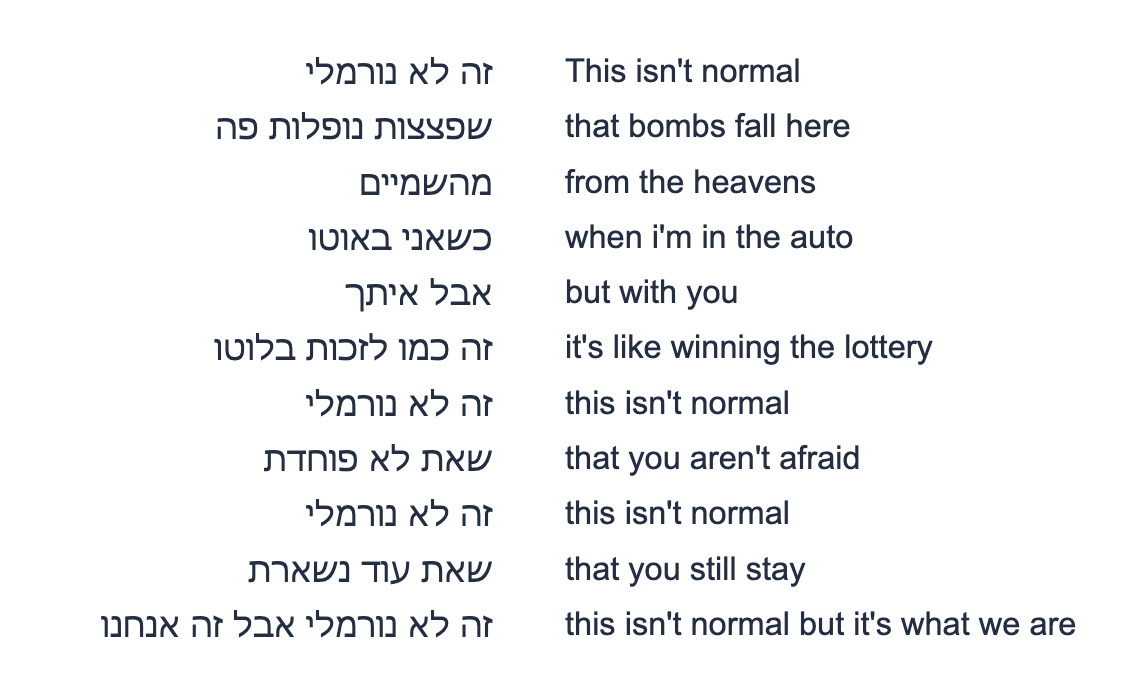
The car ride back to the kibbutz is peaceful. Gidon’s son puts the radio on Galgalatz, the army-run radio station staffed largely by soldiers doing their military service. One of my favorite songs comes on: “Halevai” (if only) by Hanan Ben Ari. It’s a song about life in Israel for the past almost three years. About the missiles, the fear, and the pining for normalcy to return.
We are on Road Six again, which passes by the barrier wall between Israel and the West Bank near Tulkarm. One kilometer away, on the Israeli side, we pass Bat Hefer. Residents there have reported hearing digging sounds at night for years and are worried about what might be happening beneath the ground.
I put my hand over my heart. I feel worried about the future. Being in “the now-ness” is hard.
The night passes peacefully, back in our little house up on a hill. Our iron window shutter, meant to make our bedroom a “safe room” when missiles fall, is wide open these days, letting in the fresh air. This wakes us in the morning; our whole room turns the reflected green of the curtain and the pomegranate and carob trees outside.
The community newsletter has informed us that there will be a garage sale on Ha Herov Street this morning. Of course, we go. Gidon drives the two minutes to get there. That’s the only place he drives anymore, in our small community. That way, he won’t forget how to drive entirely, and it makes him feel good. Two elderly couples are sitting on the front patio, in the shade, listening to a radio. Everything is for sale - everything! they say.
Orly has decided to move into an assisted living community. Her husband has fallen five times recently - their new home has no stairs, a pool, and activities. They are happy to be going. Their daughter offers us lemonade.
The patio is strewn with items for sale - a coffee maker, a SodaStream, an iron and two chairs. In a box, there are small dolls, some still in packages, most not. They are “international” dolls, Orly tells me. A Japanese geisha, a Swedish milkmaid. These dolls are decades old. I pick up one; it’s a dark-haired woman holding a spindle in one hand. She wears an elaborately embroidered red skirt and apron. I like this doll.
Orly tells me it’s from Serbia, see the needlework? That’s traditional there. Orly’s parents were from Serbia. They met after the war. Orly’s mother, thirty-one at the time, weighed 35 kilograms (77 pounds) after a year in Auschwitz. She was so weak that when the Germans emptied the camp ahead of the arrival of the Russians, they left her mother there to die in the snow. The Russians found her, though, and she was hospitalized for a long time. She was always sick, for the rest of her life, Orly says.
Her parents were from the same village in Serbia. Each was married to a sibling of the other. When they came back home after the war, they found that everyone had died. So they married each other and came to Israel in 1949.
I tell Orly to keep the doll, it has special meaning for her. “No, take, take!” she says warmly.
I put the hand holding the little doll over my stomach. I feel the dull ache of sorrow.
We head to Zarzir, a nearby Bedouin village, to shop for fruit, meat and cheese. Gidon adds that he’d like to stop at the candy place. Someplace in Zarzir, off the main road, an Iranian ballistic missile struck during the war in March. I am curious to see the crater where it hit, and the damage around it, but I don’t want to be a looky-loo, so we head home instead.
After tea, we settle ourselves around the TV to watch the French Open. We love watching the Grand Slam tournaments together. We’ve gotten to know most of the players. We love to hate Sabalenka because she’s good, but she’s bratty, which gives her a lot of character.
On TV, there’s a really great match between someone named Kouwame (the French favorite) and Talbino, from Chile. During a commercial break, I hear the “boomim” (Heblish for the plural of booms). I haven’t heard that terrible thud thud KA-BOOM sound in awhile. Though that fighting has really never stopped, Hezbollah has not fired missiles into Israel beyond the border communities since the ceasefire.
Talbino wins the match, and I’m torn. Kouwame really was charismatic and so young, only 17. But Talbino had a tough crowd, and he played well.
Later, the news tells us that IDF soldiers are fighting to capture Beaufort Castle in Lebanon. By evening, Israeli forces have taken it. Soldiers raised an Israeli flag over the fortress for the first time in more than twenty-five years. In a straight line, Beaufort Castle lies only about 35 miles away from our television broadcasting the French Open.
Pock pock applause pock pock applause.
The next mid-morning, I walk to our local market to buy hot dog buns. Gidon’s asleep on the couch again. He naps several times a day lately, and there is the feeling of a new, ghostly presence in our home together. Something in the corners that you can’t see.
At the market, Fatima, the usual young lady from Zarzir, is not there. It’s someone new. She’s married, I guess, because she’s wearing a hijab. She’s less friendly, too; I try to make small talk, and it goes over like a lead balloon. Oh well, I’ll keep trying.
I realize on the walk back home, several of the usual young ladies who work at the market and live in Zarzir have not been there lately. Where have they gone? How am I only just now noticing this? Where has my head been? Why am I having such trouble writing lately? Staying organized? Calling people back?
I feel disoriented in my own day-to-day reality. There is too much contradiction, too many variables, too many unknowns.
Ze lo normali.
I take Pema’s advice again, and I put my hand on my throat, no, my heart, no, my solar plexus. I give up and hug myself, but that feels weird. Get a grip on yourself, I think, and laugh to myself. Make yourself useful. After all, I told my friend Nancy that I couldn’t meet up for coffee today because I was working on my book. I did “work” on it, so to speak. I stared at the manuscript for hours, in fact.
I am aware that I am feeling mild anxiety, guilt and dissatisfaction with how I spent my day. Okay, that’s a Buddhist baby step, but I’ll take it.
I glance at the clock, and it’s been exactly 48 hours since Friday afternoon, when we left for the kibbutz to go to Jerusalem. I feel restless, so I make Gidon his afternoon tea and give him some homemade lemon cake and a scoop of ice cream. He’s happy.
I practice doing some writing, if not on my book, on my Substack, where I have autocratically granted myself permission to not always make sense.
At least I am using a keyboard and typing stuff.
Somewhere, someone will read it and nod, roll their eyes or forget it entirely. That seems worth it.
I put my hand over my heart one last time.
To be honest, I don’t know exactly what I’m feeling.
But at least I’m paying attention.
Postscript: I have noticed that I have a great number of new followers lately. Welcome!
We share this, but I've come to believe it's a strength, however painful:
'I feel grief and loss about something that hasn’t yet happened.'
Hand on my heart reading this.